


 32 / 68

meditation
32
MAY / JUN 2015
I
Healthcare Journal of new orleans
maintaining genomic stability.
In addition to the Bhasin et al. transcrip-
tome study, several other reports have found
a reduction in oxidative stress in response
to meditation. One such study looked at
Kouksundo, a traditional Koreanmind–body
practice that is similar to yoga but empha-
sizes deep-breathingmeditation.After prac-
ticing Kouksundo for an average of about 3
years, participants had significantly lower
reactive oxygen species, as well as signifi-
cantly lower nitric oxide and malondialde-
hyde levels, all markers of oxidative stress,
and reduced levels of the stress hormones
cortisol and norepinephrine.
Another body of research has examined
neural changes associated withmeditation.
Structural changes seen in long-termmedi-
tators include increased cortical thickness
in a number of areas, increased gray mat-
ter density, increased hippocampal volume,
and reduced age-related loss of gray mat-
ter. Changes in white matter can already be
detected after just short-term meditation
training. In terms of outcomes, mind-body
techniques likemeditation have been shown
to be effective against a range of mental
health disorders, from depression to PTSD,
while significantly reducing perceived stress.
The use of meditation in the hospital
is also growing. However, “we tend to do
this very late in disease,” states Dr. Parada.
“Cardiac rehabilitation, pulmonary reha-
bilitation...we tend to do it very late in the
spectrumof the disease, but we really should
start these things as young as possible.”
According to Dr. Parada, most people don’t
realize howmuch stress they are under and
what a profound effect it can have. “You have
to motivate people very kindly to become
aware that they do have stress in their lives,”
she says, adding that stress can take many
different forms, and that there are good
stressors and bad stressors. “There can be
family tensions, work tensions, relationship
tensions, and financial stress, which can be
a very big one”, but “even good changes in
life, like a new job or a new child, can have an
effect on the body physiologically.”Medita-
tion, as well as other tools like biofeedback,
can help foster this kind of awareness and
help induce the relaxation response needed
to balance the stress.
While the scientific study of meditation is
in its infancy, the belief in its power for well-
being is far fromnew. “Half an hour’s medi-
tation each day is essential, except when you
are busy. Then a full hour is needed.” This
prescription, made way back in the Renais-
sance by Catholic priest Saint Francis de
Sales, concurs with the beliefs of contempo-
rary Buddhist leaders likeThich Nhat Hanh
and the Dalai Lama. Sufi and mystic Jewish
traditions have also embraced the value of
meditation, as have Hindu practices predat-
ing the Buddha by over 1,000 years. Now,
it’s science’s turn, and an expanding body
of data is supporting meditation’s potential
as a tool for healing, preventative medicine,
and well-being.
n
The x-ray image intensifier allows
dynamic x-ray imaging that can
be shown on television screens.
1945
First visualization of
the coronary arteries.
1946
Development of the film cassette changer by
George Schoenander allows for a series of
cassettes to be exposed at a rapid rate.
1955
e
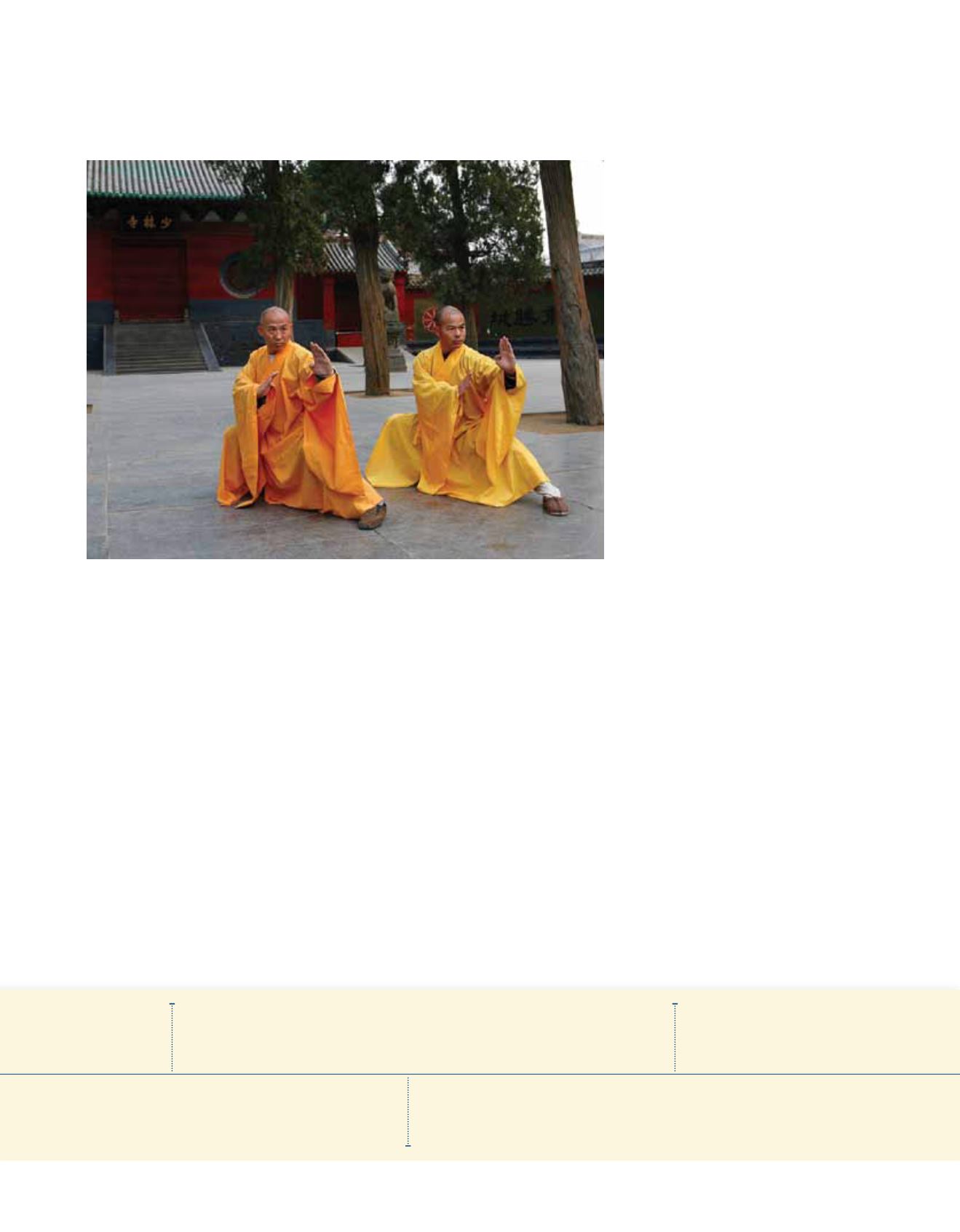
Shi Deru (Shawn
Xiangyang Liu, left) with
fellow Shaolin Temple
grandmaster Shi DeYang
(Shi WanFeng), both
decedent disciples of the
late Great Grand Master
of the Shaolin Temple Shi
SuXi. Shaolin Temple,
Zhengzhou, China.