


 29 / 68

By
Claudia S. Copeland, PhD
he idea that meditation is a healthy activity has been around, continuously and across the
globe, since ancient times. (The word has the same etymological roots as “medical”—the
Latin “mederi”meaning “to heal”.) Only recently, though, have biomedical scientists begun
to understand the mechanisms underlying meditation’s beneficial effects, and the broad
power of this simple practice to enhance health. The acceptance of meditation’s power to promote
health is steadily growing amongWesternmedical practitioners. Moreover, spurred by the burgeon-
ing problemof chronic conditions like cardiovascular disease and diabetes, even health insurance
companies have become interested in exploring this ancient practice.
Meditation is a single term for a variety of methods, some recently developed, some ancient,
that involve quieting and focusing the mind in order to achieve mental and physical benefits.
Two of the most popular and well-known meditation methods are concentrative meditation (a.k.a. focused
attention meditation) and mindfulness meditation (a.k.a. open monitoring meditation).
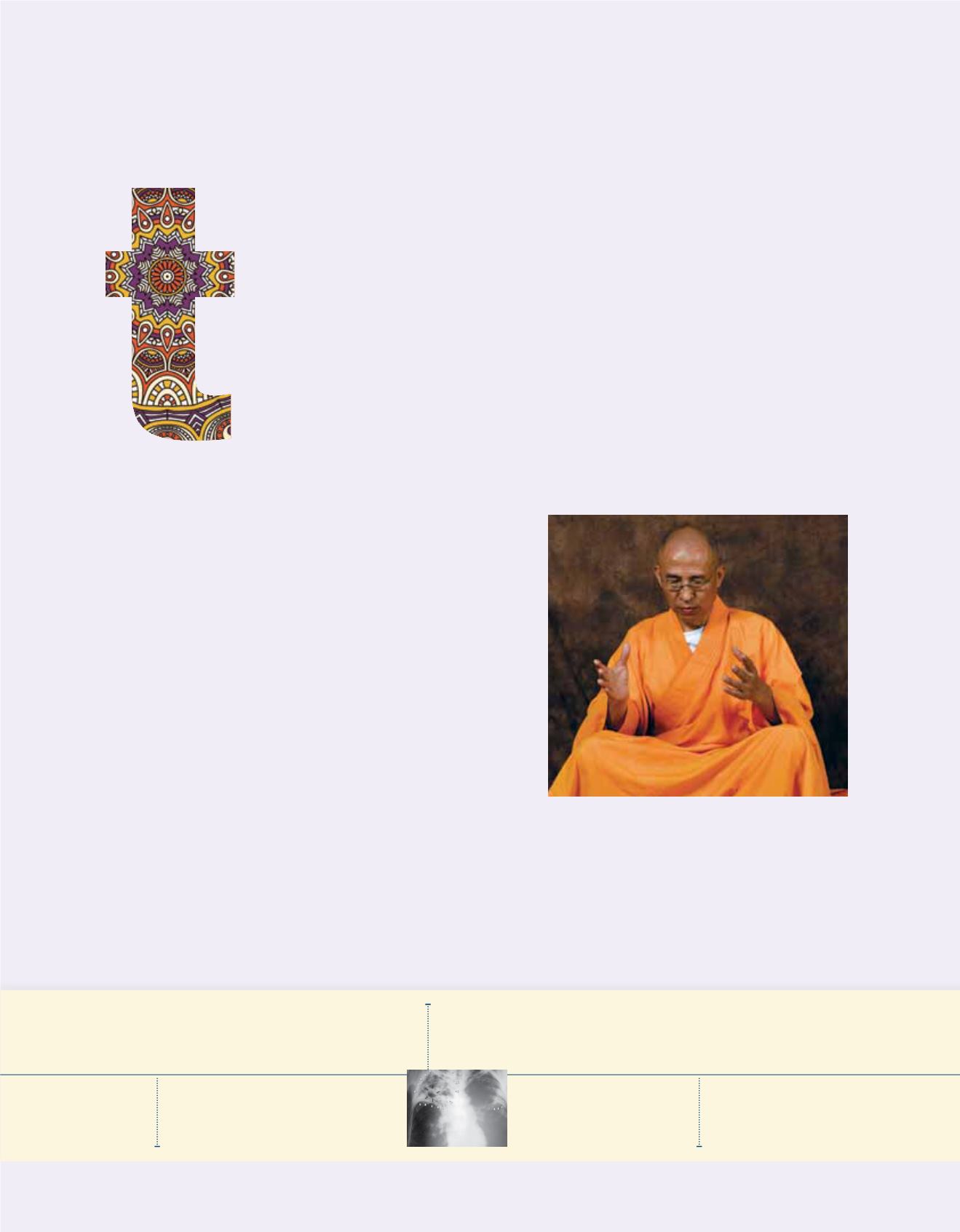
“To meditate is to let [the
life energy of the body]
freely balance and flow.”
– Master Shi Deru
Concentrativemeditation, which includes transcendental medi-
tation and guided imagery/visualization, focuses themind through
concentration on a repeated mantra, image, or idea.
Mindfulness meditation, which includes Zen meditation, is
based on cultivating a sense of awareness of one’s thoughts, feel-
ings, breath, and/or environment. Encouraging nonjudgmental
awareness or observation of thoughts, emotions, and/or percep-
tions, this method is akin to a type of focused listening. Qi gong, tai
chi, yoga, and walking meditation use movement as an additional
point of focus to cultivate a meditative state.
What these different practices share is the achievement of a
state of calm focus that both relaxes and energizes the body. This
is not a sleepy or “zoned out”trance state. On the contrary, a recent
EEG study of Zen meditation by German and Italian researchers
Hauswald et al., suggest that it is a highly active state of mind. In
the words of Shi Deru, “To meditate is to let [the life energy of the
body] freely balance and flow.”One practitioner described it as the
state you would want to be in if you were a samurai warrior—calm,
focused, and highly aware; that is, not frenzied or agitated but not
drowsy or lethargic, either.
For those of us who hold no ambitions to be samurai, kung fu
temple defenders, or any other kind of warrior, though, is it worth
the effort to cultivate this state? Is this really a practice for ordinary
Radiology becomes
a sub-specialty
1896
Improving on Hale’s manometer,
S. Riva Ricci invents the
sphygmomanometer for measuring
blood pressure.
1900
Chest x-rays allow for early
diagnosis of tuberculosis
c. 1905
e